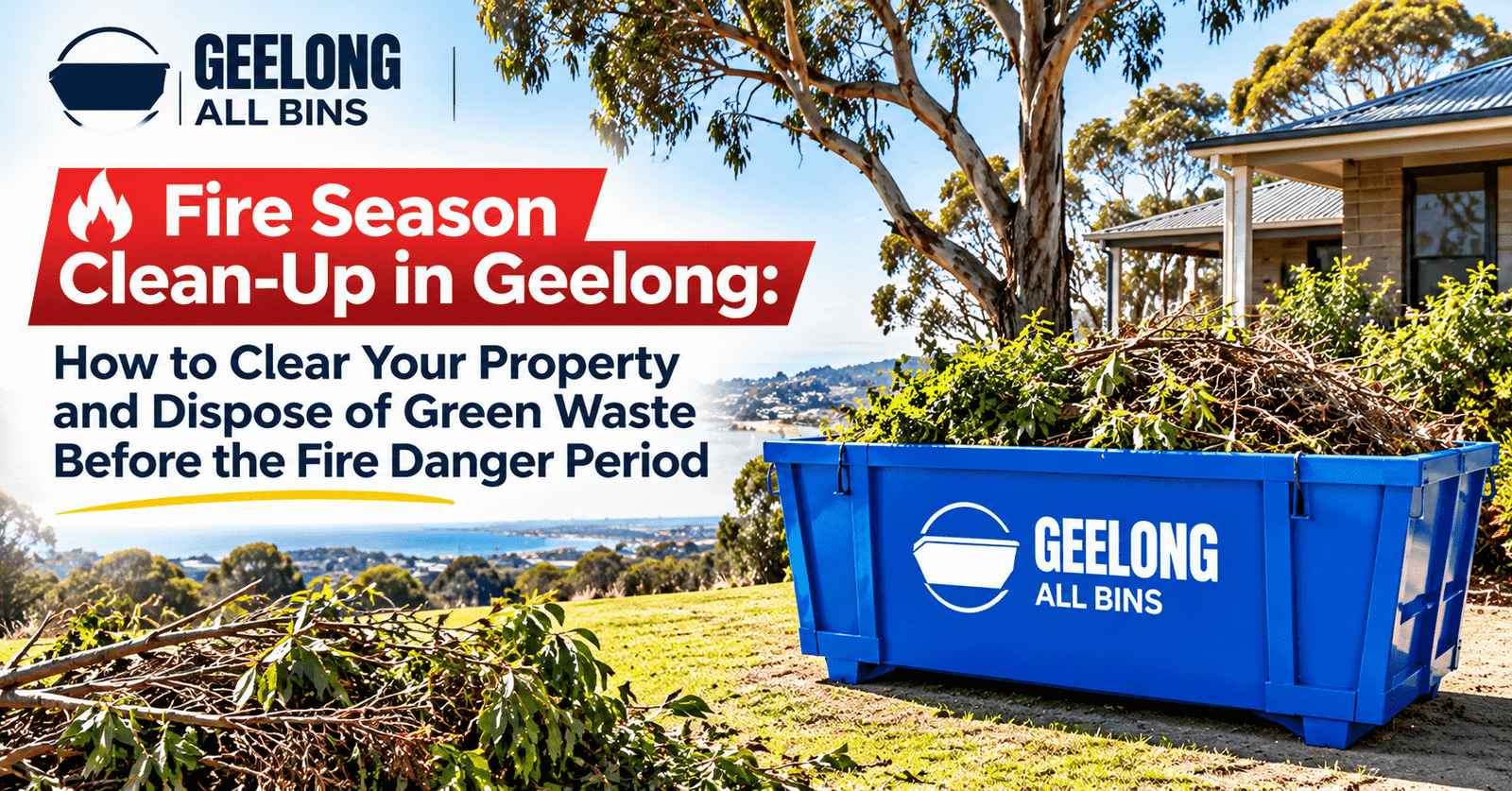
Every spring, the same thing happens across Geelong, the Surf Coast and the Bellarine: the grass shoots up, branches come down, and the pile of cuttings at the back of the block gets bigger than anyone planned. Then the Fire Danger Period arrives, council fire prevention officers start inspecting properties, and that pile becomes a problem. Here’s how to get your property fire ready, what the rules mean for green waste, and how green waste removal in Geelong works with a skip bin, so you can dispose of it without lighting a match.
When Does the Fire Danger Period Start?
The Country Fire Authority (CFA) declares the Fire Danger Period (FDP) for each municipality separately, based on rainfall, grass curing, fuel dryness and weather. For the City of Greater Geelong, Surf Coast Shire and Borough of Queenscliffe, recent start dates have landed in the second half of November, with earlier years starting in December. The period typically runs until autumn.
The exact date changes every year, so check the CFA fire restriction dates page for the current declaration. The smart move is to clear your property before the date is announced, not after.
What Are Fire Prevention Notices?
Under the Country Fire Authority Act, councils have a duty to reduce fire risk, and property owners are responsible for keeping their land free of fire hazards. In the lead-up to the FDP, the City of Greater Geelong’s fire prevention officers inspect properties, and owners of properties judged to be a risk can be issued a Fire Prevention Notice listing the work required and a deadline.
If the work isn’t done, the council can engage a contractor to complete it, and the cost can be passed on to the owner. Avoiding that outcome is far cheaper and easier than responding to it. For the council’s current guidance, see the City of Greater Geelong fire restriction page.
What Does “Fire Ready” Actually Involve?
Requirements vary by property, and the notice or council guidance is the final word. In general, preparation includes:
- Cutting and maintaining grass, weeds and undergrowth to a low height (the City has advised under 100 mm during the FDP)
- Clearing fallen branches, bark and dead vegetation, especially near buildings and fence lines
- Removing other combustible material, such as stacked timber offcuts, old pallets and piles of dry garden waste
- Cleaning gutters of leaves and debris
- Tidying around sheds and outbuildings, where flammable clutter tends to build up
Every one of those jobs produces waste, and a lot of it. Green waste is bulky, and it adds up faster than most people expect.
Why Burning Off Isn’t the Easy Answer
Many people’s first instinct is to burn the pile. During the Fire Danger Period, burning off requires a permit, strict conditions apply, and the permit holder carries the liability. Penalties for lighting fires in the open without a permit during the FDP can be severe. Incinerators are banned across the City of Greater Geelong at all times, and permits issued before the FDP starts can expire when it begins, so don’t assume an old permit still applies. For current rules, check with the council and Fire Permits Victoria.
Even where burning is allowed, it takes time, creates smoke, and carries real risk. A skip bin removes the pile entirely, with no permit, no flames and no escaped-fire worry.
Using a Skip Bin for Green Waste
A skip bin is one of the most practical ways to clear a fire-risk property quickly. Here’s what to know.
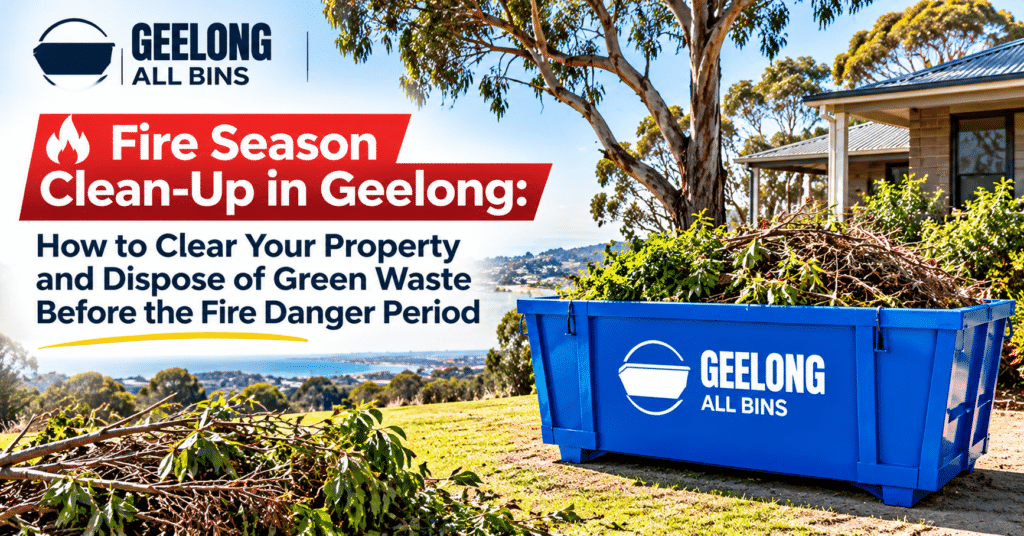
What goes in: Branches, prunings, grass clippings, weeds, leaves, bark, dead plants and general garden waste.
What size? As a rough guide, a 6m³ skip suits a typical suburban garden overhaul, while larger blocks, bigger trees or lots of undergrowth often need an 8m³ or 10m³ bin. Green waste is light but bulky, so it fills a bin quickly. Cut long branches down so they sit flat and use the space well. Our skip bin sizes explained guide translates each size into ute and trailer loads.
Cost: Skip bin hire starts from $320 for a 3m³ skip and $570 for a 6m³ skip, including delivery, a 7-day hire, pickup and disposal.
Save with single-stream: A bin containing only green waste is easier to sort and recycle than a mixed load, and typically attracts a discounted rate. Keep soil, rubble and general rubbish out of your green waste bin.
What can’t go in: Hot ashes or embers, liquids, fuel, chemicals and gas bottles. Asbestos is never accepted, which matters if you’re clearing around an older fibro shed. See our guide to asbestos and skip bins in Geelong.
Where Does Your Green Waste End Up?
Green waste doesn’t have to mean landfill. Geelong All Bins is the region’s only EPA Approved Recycler, diverting up to 90% of collected waste from landfill, and garden waste is typically processed into mulch and compost. Read more in our guide to EPA approved recycling in Geelong.
Tips for a Smooth Fire Season Clean-Up
- Start early. Inspections begin before the FDP does, and bins book out when everyone rushes at once.
- Walk the whole property first. Note every pile, fence line and shed so you can size the bin correctly.
- Load smart. Break down branches, load flat, and stay under the fill line.
- Consider a second bin. Large blocks sometimes need a change-over. Ask about it when you book.
- Need it fast? Same-day and next-day delivery is often available.
- Torquay, Ocean Grove and Bellarine residents can find local details in our Torquay and Bellarine skip bin guide. While you’re clearing the shed.
Get the cutting done, fill the bin, and let us haul it away before the notice or the season catches up with you.
Get a free skip bin quote from Geelong All Bins or call 03 5277 1007.
The CFA declares it each year based on local conditions. Recent start dates for Greater Geelong, the Surf Coast and Queenscliffe have fallen in the second half of November, so check the CFA's fire restriction dates page for the current declaration.
It's a notice issued by the council to a property owner whose land is judged a fire risk, listing the work required and a deadline. If the work isn't done, the council can send a contractor and pass on the cost.
During the Fire Danger Period, burning off requires a permit with strict conditions, and incinerators are banned in the City of Greater Geelong at all times. A skip bin avoids the permit, the smoke and the risk entirely.
A 6m³ skip suits a typical suburban garden clean-up, while larger blocks or heavy undergrowth often need 8m³–10m³. Green waste is bulky, so cutting branches down helps you fit more.
With Geelong All Bins, yes. As the region's only EPA Approved Recycler, up to 90% of collected waste is diverted from landfill, and garden waste is typically processed into mulch and compost.